Courier Management System
Turning courier selection from a guess into a decision — giving 3,000+ D2C brands the ratings, serviceability data, and AI-backed insight to choose the right courier themselves, without calling support.

When Every Courier Looked the Same
Panel users were choosing couriers with zero data support — no rating, no serviceability check, no AI insight. Every option in the list looked identical, so there was nothing to actually decide on. They either guessed, or escalated to support to decide for them.
A flat, manual list with no ratings, no performance history, no AI insight — every courier looked the same, so there was nothing to actually compare.
No way to tell, inside the panel, whether a courier even served a given pincode reliably — that knowledge lived outside the product entirely.
Users couldn't trust their own courier picks, so they escalated to Shipway's support team — turning a self-serve decision into a repeat manual task at scale.
Some merchants optimize for cost, others for speed, others for reliability. The panel gave every user the exact same ranked list regardless.
What Trust Would Require
Not a checklist of features — a definition of what "trustworthy" would actually mean to a merchant who'd been guessing until now.
The Merchant Guessing, The Team Answering
Same broken workflow, two different costs — one person guessing on every order, another answering the same question a hundred times a week.
"I don't know which courier actually delivers well in my customer's pincode. I just pick whoever I picked last time and hope."
- Ship confidently without guessing
- Optimize for what matters to him — cost, most months
- Trust a recommendation without double-checking it
- No rating or serviceability visibility before choosing
- Had to message support for every uncertain call
- One ranked list didn't reflect his actual priority
"Half our tickets are 'which courier should I use for this order.' We're answering the same question a hundred times a week."
- Cut repetitive courier-choice escalations
- Let the product answer routine questions, not the team
- Free up team time for genuinely hard issues
- No self-serve data to point users toward
- Manually recommending couriers didn't scale with brand growth
- No visibility into why users kept choosing wrong
One Courier Partner, Many Different Products
A single courier partner isn't one thing — Surface, Air, and Hyperlocal, each with its own weight slabs and pricing logic. Six modules exist because that complexity had to be made manageable, not hidden.

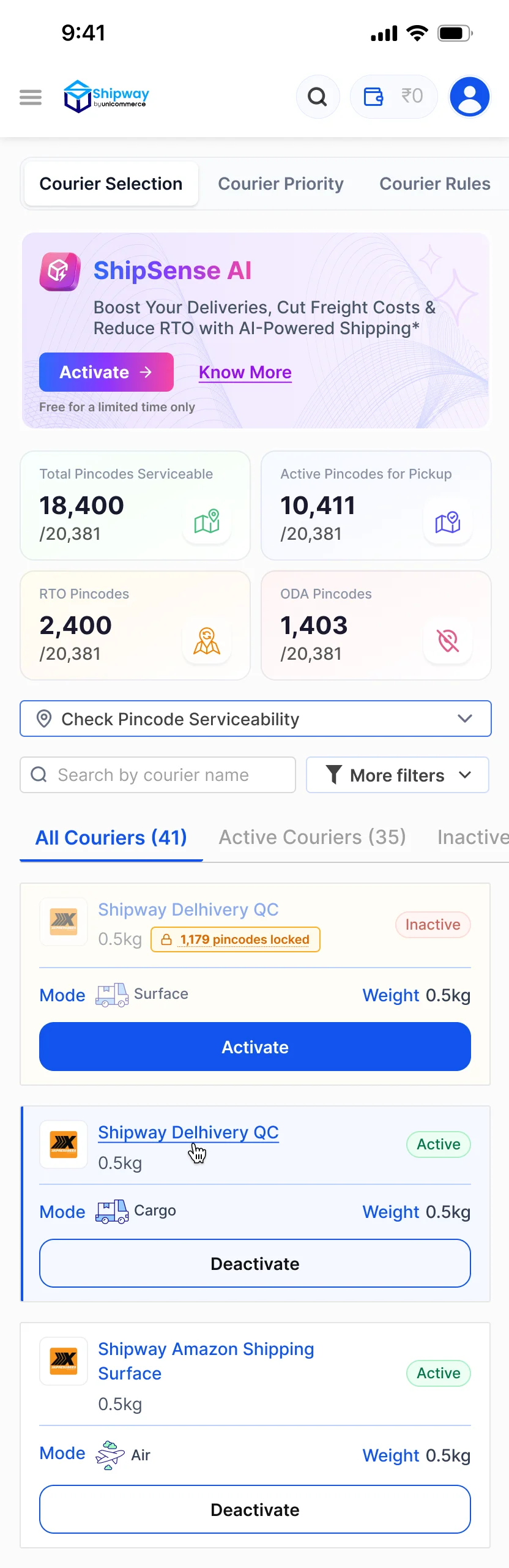
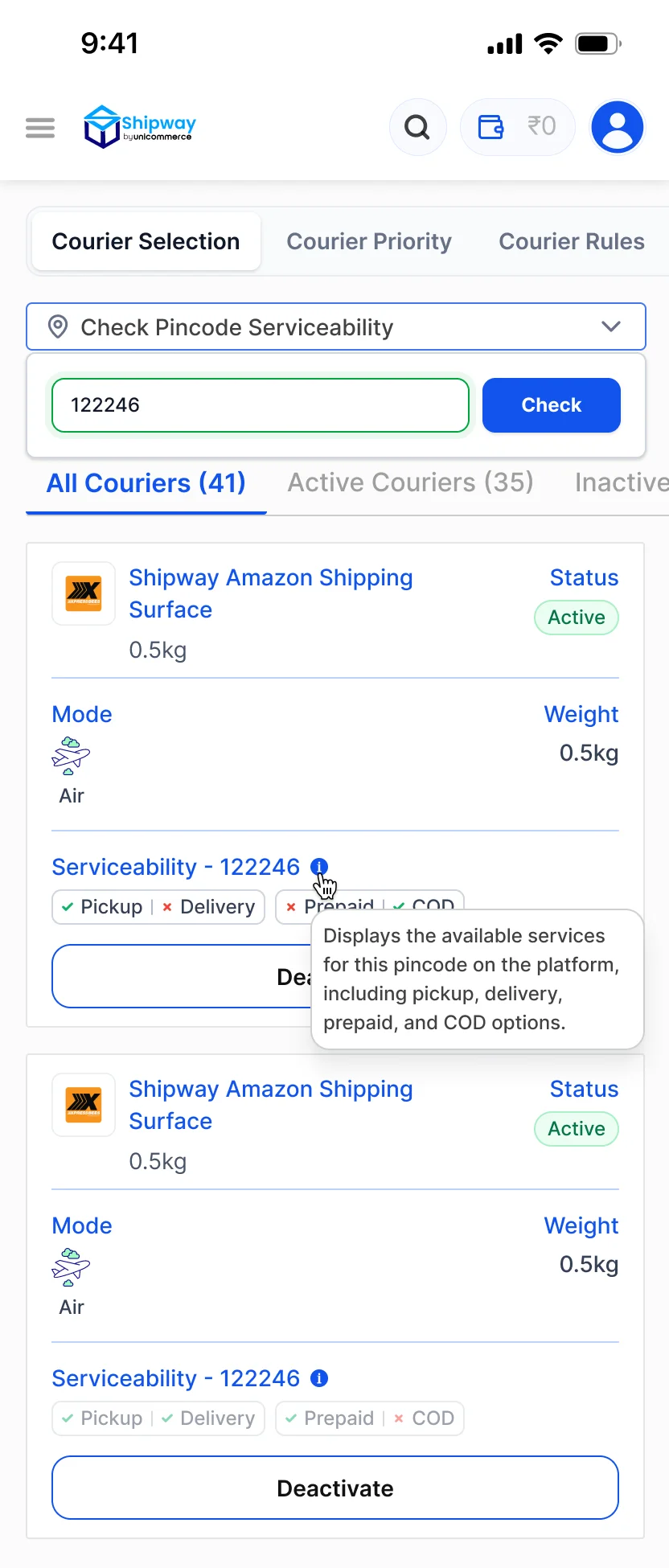
Full listing with live serviceability checks, ratings, and pincode-level control — the entry point for every decision.

AI-powered recommendation, balancing speed, reliability, and cost — with the reasoning shown, not hidden.

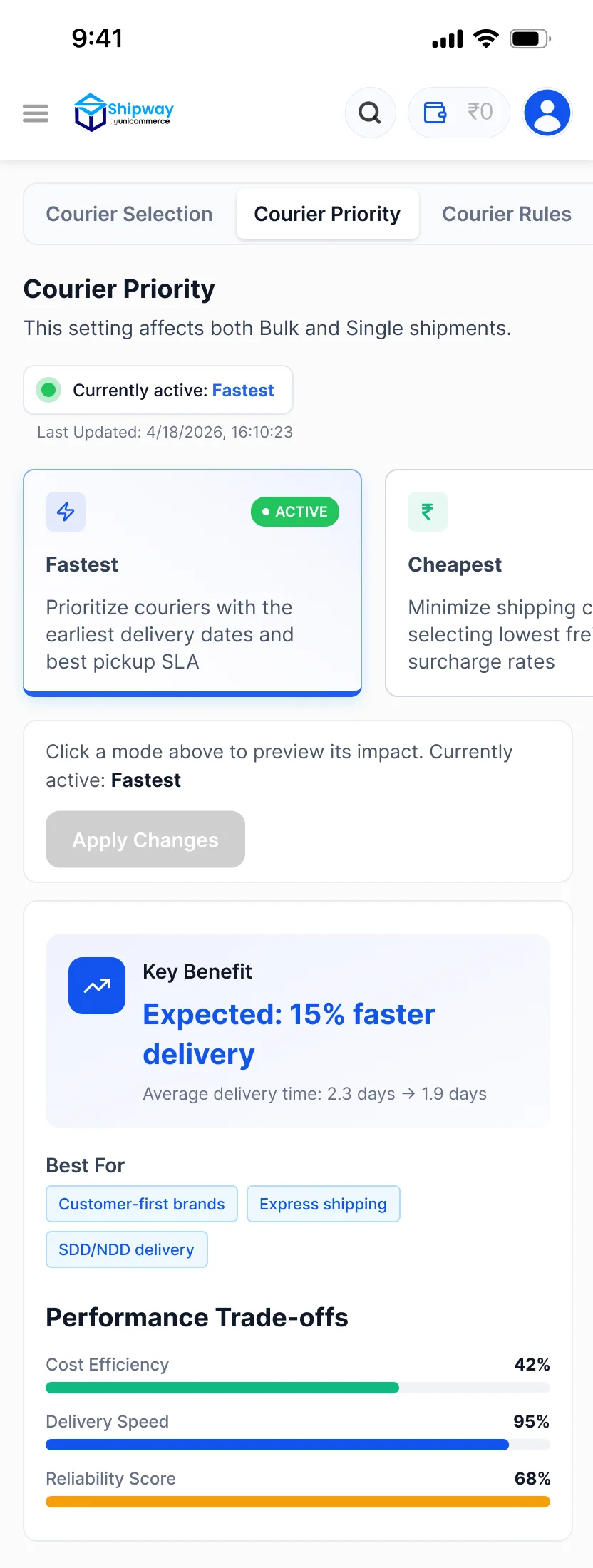
Fastest, Cheapest, Best Rated, ShipSense AI, or Custom — priority logic that matches how each merchant actually thinks.

Conditional logic for courier selection at scale — set once, applied automatically going forward.

Automatic courier assignment for high-volume merchants who've outgrown manual selection entirely.

Per-courier analytics — serviceability, RTO, and ODA intelligence — the "why" behind every rating number.
Why Show the Machine's Thinking

Why show the AI's reasoning instead of just automating?
The easy version of this feature auto-picks a courier silently and calls it done. We didn't build that. Users had already been burned by bad guesses — a black-box recommendation, however accurate, wasn't going to earn their trust. The adoption lever wasn't accuracy alone. It was transparency.
- Comparison table shown before commitment — Current Allocation vs. ShipSense AI, visible before activation, not after.
- "How ShipSense Works" — a plain 3-step model so the recommendation never feels like a black box.
- FAQ addresses control directly — cost, reversibility, effect on COD, override rights, answered upfront.
- Real per-merchant numbers — the comparison is calculated from the merchant's own account data, not a generic marketing claim.
From Guesswork to a Defensible Choice
ShipSense AI
AI-powered courier recommendations, balancing speed, reliability, and cost — with the reasoning visible, not assumed.
- Live comparison — Current Allocation vs. ShipSense AI, calculated from the merchant's own data
- Transparent 3-step "How It Works" model, plus an FAQ that addresses control directly


Courier Priority
Five priority modes so "best courier" can mean something different for every merchant.
- Fastest, Cheapest, Best Rated, ShipSense AI, Custom Priority
- Confirmation flow before switching active priority — no silent changes
Courier Rules
Conditional courier logic that scales — set once, applied automatically to every future order.
- Central rules listing with clone and edit support
- Confirmation modal before a rule change goes live


Safe Deactivation
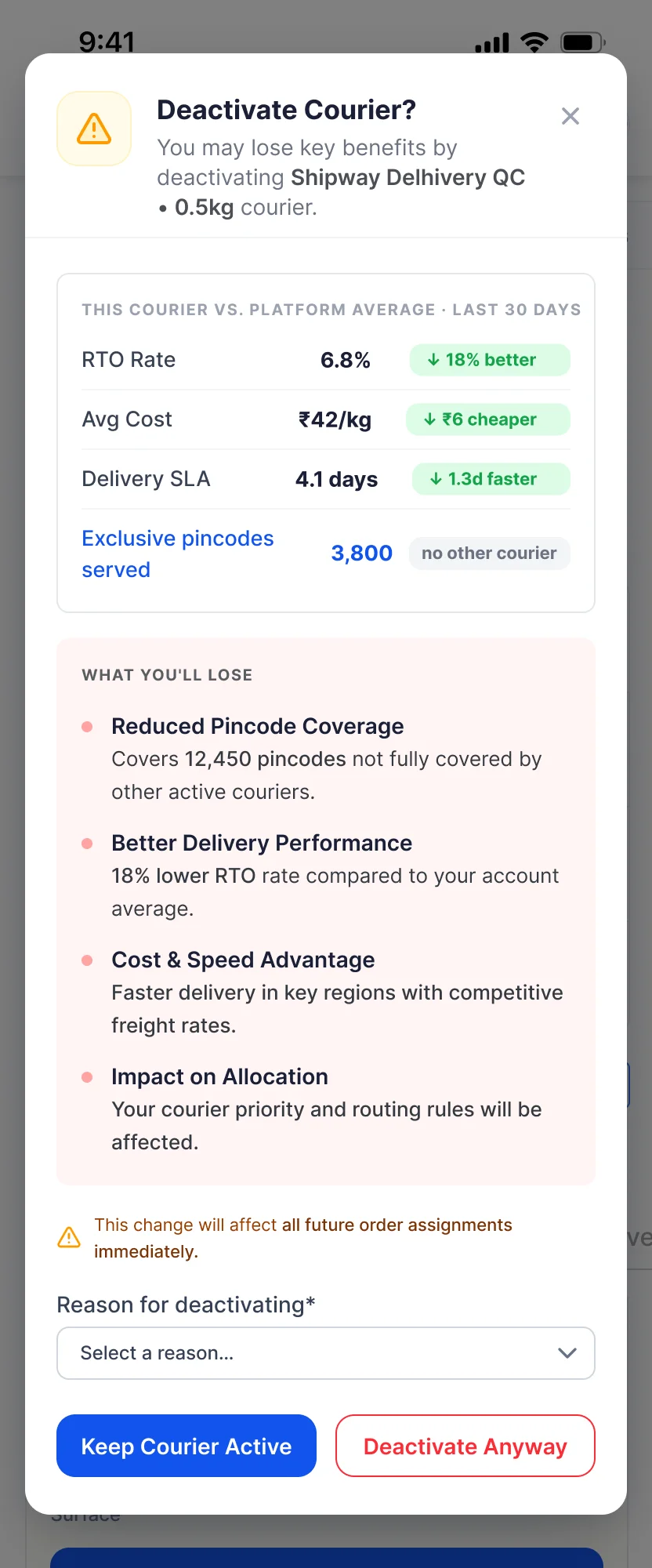
Before removing a courier a merchant relies on, show them exactly what they'd lose.
- Courier performance vs. platform average, shown before the decision
- A specific "What You'll Lose" list — coverage, RTO performance, cost/speed advantage
The Same Confidence, In Your Pocket
A courier decision doesn't wait for a desk. Selection, AI recommendations, pincode control, and per-courier analytics — all reflowed for mobile web.


From Guess to Confirm
The happy path — and where the system makes the decision easier so the merchant doesn't have to guess.
Where the System Earns Trust
The Problem section was about a trust gap. These are the exact moments where that trust either gets built or breaks — again.
"No couriers match your filters. Try adjusting mode, weight, or status."
Clear reset action offered — never a dead end.
"1,179 pincodes locked" — shown on an inactive courier before reactivation.
Users see exactly what reactivating unlocks, before committing.
"One pincode per row · Max 10,000 pincodes per upload."
Constraint stated upfront in the upload zone — not discovered via an error after upload.
ShipSense AI / Auto Assignment — pre-activation guidance state.
New users see what the feature does before being asked to activate it.
"Serviceability dropped — 2 regions. 134 pincodes unserviceable in 7 days."
Proactive, not buried in a report the user has to go looking for.
"RTO Spike Detected — 3 regions. 47 pincodes crossed the 10% threshold."
Paired with a direct "Block Pincodes" action — insight and response in the same place.
A Rating Number Was Never Enough

Designed for the operator, not the analyst
A merchant checking a courier's health doesn't have time to cross-reference a report. Every element on this screen was chosen against one test: does this tell them what to do next?
We chose regional heat-maps and inline "Smart AI Insights" callouts over raw data tables — so the operator sees where to act, not just what happened.
Where Things Stand Today
Live since June 2026 — too early for a full before/after study, so these are scope facts, not outcome percentages. A detailed breakdown will follow once the module has more runway.
I make data-heavy decisions clear and trustworthy.
I'm Ankur Bhatt — a product designer with 13 years across logistics, pricing, and AI-driven B2B tools. Today I'm Senior Product Designer at Shipway, designing the courier-intelligence, failed-delivery, and support tools that 3,000+ D2C brands lean on under pressure.
I started in graphics, moved through web and three years of production frontend, then into product — so I read a decision from four sides at once: what to build, how it's built, what's right for the user, and what the business needs. That's what lets me turn dense, high-stakes screens into decisions people trust.
If you're building something data-heavy and want it to feel clear — let's talk.
Open to Senior / Lead Product Design roles — Delhi NCR, Remote, or Hybrid.